Overview
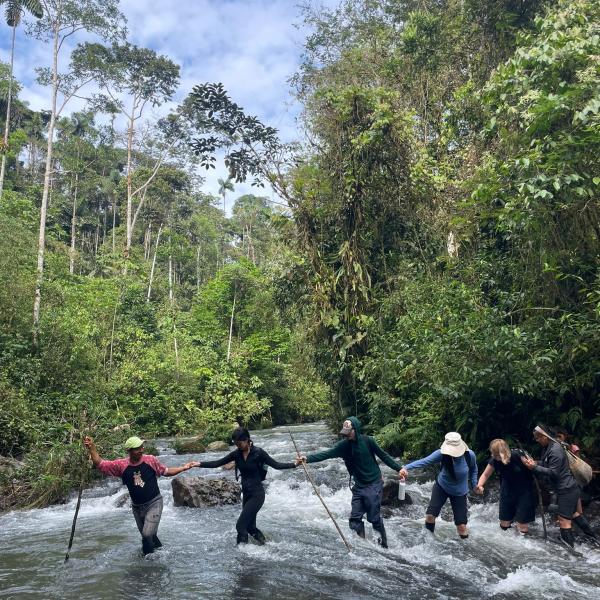
This winter program will include a required spring course for the first seven weeks in spring with classes on Wednesdays from 10:10am-12:05pm. Ecuador is one of the most biodiverse and climatically varied countries in the world. We will explore a massive altitudinal gradient ranging from the Andes to hyper diverse tropical forests, with a focus on understanding the ecology of these stunning ecosystems and how species within them evolved. The course begins with a cohort building retreat that includes safety workshops and a tutorial on cultural humility at the end of the fall term. The field course begins in Quito, with an in-country orientation at Cornell's partner institution, the Universidad San Francisco de Quito (USFQ). From here we will travel to Cayambe-Coca National Park, where we will hike in the Paramo, a high-altitude ecosystem known for stunning morphological adaptations and high degree of endemism. From Quito, we will then embark on a two-day journey to a hyperdiverse lowland tropical rainforest, including a day-long boat ride on tributaries of the Amazon. We will stay a Tiputini Biological Station in Yasuni National Park – one of the most biodiverse places on earth, filled with enormous tropical trees, a large canopy filled with fascinating epiphytes and lianas, multiple species of monkeys and tropical birds, and a stunning diversity of arthropods. We will explore the rainforest through a series of hikes, canopy access, and nighttime observations, with a focus on natural history observations and their link to eco-evolutionary concepts and biogeographic hypotheses.
Through field-based and evening lectures and workshops, group projects, data collection and self-driven reflections, our journey will explore the causal reasons underlying vast differences in the ecology and evolution across these biomes and the challenges posed to scientific understanding. Students will also be given the opportunity to cultivate an interest in the biology of Ecuador by making natural history observations and transforming one of them into a short field research project. Upon returning to Cornell, we will make sense of what we observed through reflection and writing, as well as data analysis and consultation of the scientific literature. The course will make data-analysis accessible to all participants and will channel inspiration from our adventure in Ecuador into a research paper.
Program Dates:
Travel Dates: January 5-17, 2027
This program is embedded as part of a multi-term course titled Evolutionary Ecology Across Climatic Gradients. Students will receive one grade for the full course in spring semester, but MUST enroll in BOTH course modules:
- PLSCI 2535 Evolutionary Ecology Across Climatic Gradients I (Winter 2027 Field Travel)
- PLSCI 2536 Evolutionary Ecology Across Climatic Gradients II (Spring 2027, Wed 10:10am-12:05pm, First Seven Week, Jan - March)
Faculty
Daniel Anstett, Assistant Professor, School of Integrative Plant Science, College of Agriculture and Life Sciences
Chelsea Specht, Barbara McClintock Professor, School of Integrative Plant Science, College of Agriculture and Life Sciences